

You may wonder how you missed the news of Crossrail achieving its second milestone (out of five) in its opening strategy to fully open the Elizabeth line. The reason is simple. It hasn't been publicised. It is a contender for the title of biggest soft launch of a transport upgrade, certainly in recent times.
We exaggerate. At London Reconnections we are used to the odd ominous sentence appearing buried in the middle of an upbeat press release assuring us that all is right with the world. We live and thrive on such things. What we are not used to is a single sentence in a Letter to the Assembly confirming that Crossrail Class 345 trains are now running in public service from Paddington to Heathrow.
Let us be clear - this means that a major milestone has been achieved. What is more, the milestone has been achieved with 9-car trains with the latest problematic software crucial for full running in central London, not the 7-car trains with simplified software only really suited for above-ground services in legacy-signalled areas.
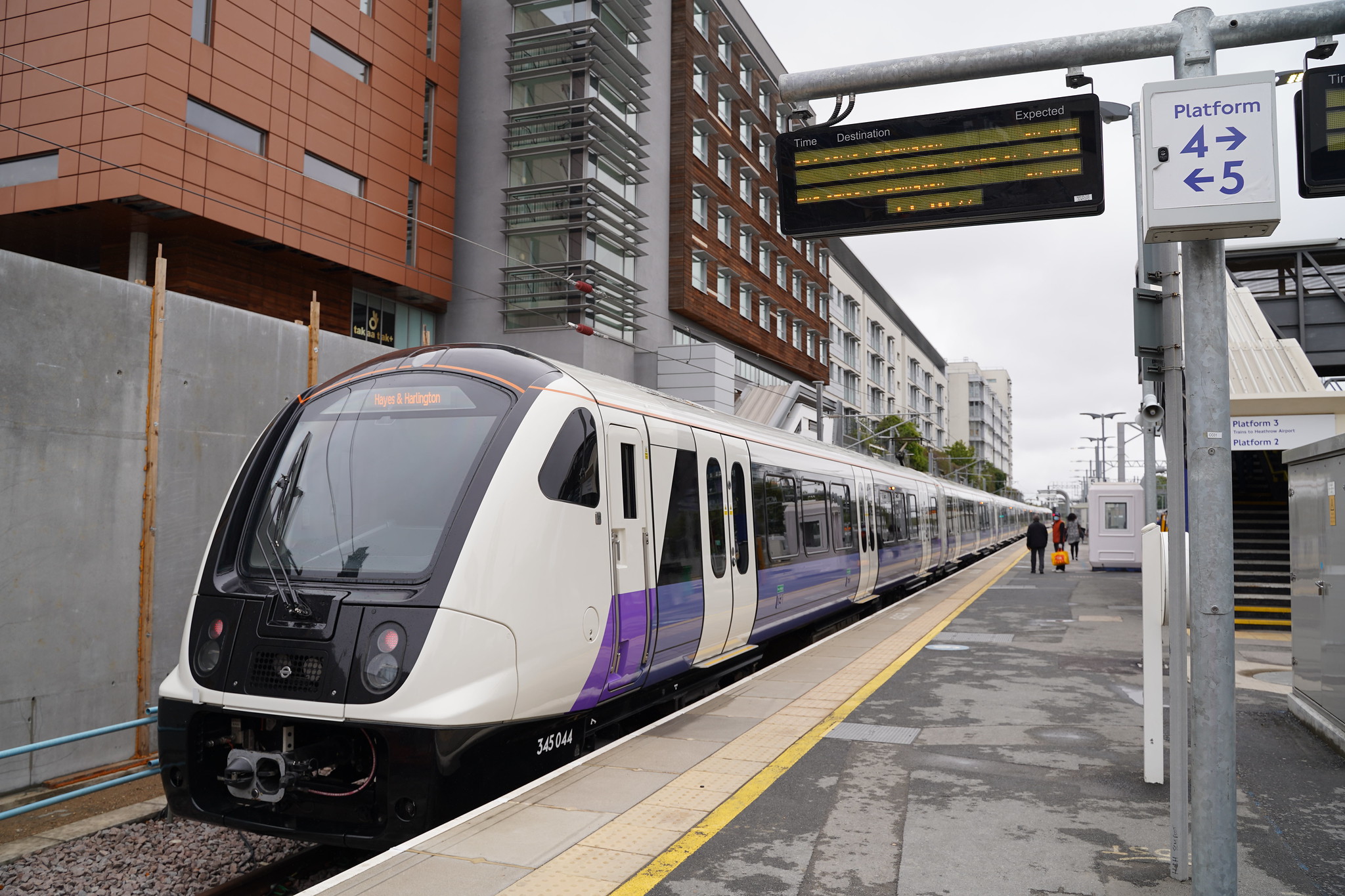
The full-length Class 345 trains (9 car units) are now operating on services out of Paddington and Heathrow. This is a significant milestone as it uses the ETCS signalling system and means that we continue to build mileage on the Class 345 fleet that will be used on the full Elizabeth line.
From the latest Crossrail press release (near the bottom)
An unusual lack of publicity
It is typical of TfL to quietly implement not-obviously-visible upgrades (such as improved frequency or changeover to automatic train operation) so that, if there are problems, they are not left with red faces. However, replacing 5-car not-very-good Class 360 trains originally used for Heathrow Connect with 9-car high capacity Crossrail trains is far from a minor improvement. It is also in great contrast to the Stage 1 opening (the first Class 345 train) on the Liverpool St – Shenfield route) which took place with much publicity. Certainly, in a Covid-19 world you don't want journalists and rail fans descending onto the line in a mass but to have virtually no official publicity at all is a bit of a shame.
It could just be that the delay to Stage 2 is rather embarrassing and Crossrail and TfL would rather not remind people of this. After all, the perception of the average person who shows any interest in this is that TfL Rail is already running a service to Heathrow from Paddington and all that has happened is that there has been a change of rolling stock. Indeed, when Crossrail had to report to the Mayor back in 2018 about the delays in opening, it rather disingenuously suggested that Stage 2 had been achieved because TfL trains were running between Paddington and Heathrow on the planned date.
2 becomes 2A and 2B
Subsequently, Crossrail became somewhat more honest and retrospectively split Stage 2 further into 2 stages – Stage 2A and Stage 2B.
Stage 2A was the takeover of Heathrow Connect service using Class 360 trains. This, to the user, involved little more than replacement of the decal on the trains to reflect its new operator (TfL Rail). In fact, the actual service available to the customer was a retrograde step because the toilets on the trains were locked out of use as it was not TfL's policy to provide toilets on trains. In fairness to TfL, their policy is to provide toilet facilities on stations. Nevertheless, given that new toilets did not suddenly appear when TfL Rail took over the service, this had to be a retrograde step at the time as far as the travelling public was concerned.
It is true that TfL's takeover of the Paddington Heathrow service led to a reduction in fares. Better still for Londoners with an Over 60 or Freedom Pass, travel between Heathrow and Paddington was now free, so long as you didn't use the Heathrow Express service.
Stage 2B, which is now at least partially implemented, is the running of Class 345 Crossrail trains between Paddington and Heathrow. There are a couple of caveats. The first is that the Class 360 trains haven't quite been withdrawn and could potentially still appear as a substitute if a Class 345 was not available. A last-minute substitution of a Class 345 by a Class 360 happened on the first day of planned operation (Thursday 30th July 2020).
The second caveat is a technicality. The planned implementation was to be between Paddington and Heathrow Terminal 4. In fact, Terminal 4 station is not served and trains are running instead to Terminal 5. The impact of Covid-19 on air travel has led to Heathrow operating everything from either Terminal 2 or Terminal 5. This is unlikely to change soon as one runway is closed to take advantage of the opportunity for major refurbishment and repair and Terminal 4 is neither needed nor conveniently sited for the other runway.
A short primer on Crossrail signalling
For those not familiar with the complexities of Crossrail signalling, it is extremely fortuitous that Crossrail have recently released an excellent video describing the challenges of signalling on Crossrail and it is well worth watching in full:
In addition, this screenshot taken from the video shows the intended final areas of different signalling on Crossrail.
The problems of ATP
This unheralded milestone may not appear significant, but it is. Regular readers may remember that there was considerable doubt as to whether it would ever be possible for Crossrail trains to use the Heathrow tunnels without switching off the obsolescent ATP (Automatic Train Protection) signalling system operating in the tunnels. ATP is used by both the Class 360 trains which deputised for the Crossrail trains, and the Heathrow Express Class 332. Unfortunately, ATP is what the electrical engineers would call 'noisy' with plenty of stray radio emissions that interfere with the modern ETCS (European Train Control System) signalling now installed in the tunnels.
At one stage it was believed that Crossrail trains might have to wait until the Heathrow Express trains were replaced by Class 387 trains operated on Heathrow Express' behalf by GWR. The fact that the original Heathrow Express stock is still operating and that Class 360 can still be used shows that ATP is still functioning in the tunnels, so the engineers working on Crossrail must have finally managed to get Class 345 trains to work in an ATP environment. It is important to give credit as well as criticise and here credit is most definitely due.
ETCS – the new baddie
In fact, as it turns out, it was not the interference of the legacy ATP signalling that ultimately delayed the introduction of Class 345 trains to Heathrow. Once that got fixed, it was the software on the trains themselves that had to work with the new signalling, ETCS (European Train Control System), that was giving problems in the train tunnels and – as it turned out – elsewhere.
ETCS generally relies on continuous communication and that is done by GSM-R, which is a dedicated radio band on the mobile phone spectrum allocated exclusively for railways (hence the -R suffix). Not surprisingly, this tends to work less well in tunnels. It also turns out that the longer the train, the more opportunity for that train to block a signal while in them. Unfortunately, but vital for safety, if the train no longer receives the expected GSM-R signal the brakes come on.
As it subsequently turned out, there were other ETCS problems too that gave issues above ground. This meant that the 9-car ETCS-enabled Class 345 trains recently introduced between Paddington and Reading had to be replaced by 7-car trains that previously ran the service.
The software on the 7-car trains is merely an update of software that has been around for about twenty years. As such it is quite crude by modern standards. It was written when ETCS was in its infancy so does not have any support for that signalling protocol and, as such, is suitable only for the older and more established TPWS/AWS (Train Protection and Warning System/Automatic Warning System). In complete contrast, the 9-car software is new and expressly written with modern signalling systems and Crossrail in mind.
Although safe, one problem with depending on the software on the 7-car trains is that it is not considered as safe as the existing system in the Heathrow tunnels, since TPWS and AWS are not considered as offering as much protection as the legacy ATP system. This means it falls foul of the Office of Rail and Road (ORR) rule that replacement systems must be at least as safe as what they are replacing.
The significance of it all
Crossrail has overcome two major hurdles. It has demonstrated that 9-car Class 345 trains can run in passenger service on ETCS-equipped lines. This means that 9-car Class 345 trains can run from Paddington to both Reading and Heathrow. With platform lengthening work at Liverpool St expected to commence by Christmas 2020, this paves the way for TfL Rail to convert all Crossrail trains to their final planned 9-car configuration. This in turn eliminates various logistical problems in keeping the two configurations in the right place for current operations. It also eliminates the problem of storing the extra two carriages at various locations in the country.
Possibly more important still, Crossrail has finally, properly, achieved its objective of running Class 345 trains to Heathrow, which was one of the five major stages of implementation of Crossrail.
In fact, no hurry
TfL Rail nearly managed to introduce 9-car trains much earlier (around May 2020), but a whole series of last-minute problems started appearing. This delayed official approval, and various technical issues followed. In normal circumstances the spotlight would have been on this issue, with the TfL Board asking questions and bad publicity in general. One effect of Covid is to take the pressure off the implementers whilst they sort out the various problems.
One reason for a lack of concern is that it was hoped the delay would mean that trains could run under ETCS from Heathrow all the way to Acton Main Line station. This would have meant that TfL Heathrow trains would only have to rely on TPWS/AWS between Acton Main Line and Paddington. Full ETCS into Paddington is unlikely to be operational in the short term due to the complexity of the layout.
As it turned out, ETCS still isn't live between Airport Junction (where Heathrow trains leave and join the Great Western Main Line) and Acton Main Line station so TfL Rail have had to accept the additional complexity of changing from one signalling system to another whilst on the move.
Benefits for TfL Rail
Once TfL Rail are committed to the Class 345, the Class 360 trains can finally be withdrawn. One presumes that TfL Rail will be pleased to see these go. As well as having to pay to lease them (even while their own trains are sitting in the sidings), they were problematic to maintain and were becoming unreliable. Indeed, if it wasn't for Covid-19 and the reduced timetable along with introduction of Class 345 from Paddington as far as Hayes & Harlington, there probably would have been a lot of bad publicity about the unreliability of the service.
Benefits for HS2
Less obvious is the potential benefit to HS2. The Class 360 trains are maintained at Old Oak Common in a depot that it shares with the current fleet of Heathrow Express trains.
The depot was supposed to be handed over to HS2 a couple of years ago but had to continue to function until the fleets of TfL-leased Class 360s and Class 332s (Heathrow Express) based there were withdrawn. It is expected that the Heathrow Express trains will start to be withdrawn in the next few weeks, when they will be replaced by GWR-maintained Class 387s dedicated to Heathrow Express, based at Reading for maintenance purposes. However, even with the current reduced requirements, the lack of Class 387 trains ready and tested for use on Heathrow Express services means that it will be some time before the entire fleet is withdrawn.
With HS2 having taken over the Old Oak Common site at the beginning of August 2020, the need to demolish the maintenance depot is becoming critical, as this is necessary before the station box can be built. It may be with the withdrawal of the Class 360 trains and the need for only a reduced fleet of Heathrow Express Class 332 trains that enough of the site can be released to HS2 so as not to delay construction.
The current situation
So far, despite the introduction of the Class 345 trains to Heathrow, the timetable remains the same. This is the temporary timetable (not published) that sees 4tph from Paddington to Heathrow Terminal 5. Two of the trains are Heathrow Express trains (leaving Paddington at xx25 and xx55) and two are TfL Rail trains (leaving at xx32 and xx02) – so there is approximately a 15 minute headway through the timetable-critical Heathrow tunnels.


No TfL Rail trains are currently advertised as running between Paddington and Hayes & Harlington (and terminating there), with the National Journey Planner not showing any indication that this service currently exists. However, sites like OpenTrainTimes.com reflect the true situation, which is that they are in fact running. TfL Rail is starting to use 9-car trains on this service. It is not known when this service will be publicised but, presumably, TfL Rail want to be confident is it reliably running with 9-car trains before doing so.
The service to Reading is intended to be run using 9-car trains but when new signalling problems with the ETCS signalling manifest themselves (regardless of whether the cause is track or train based), the 7-car trains are temporarily substituted. It remains to be seen for how long TfL Rail feel they need to keep a 7-car contingency fleet for such purposes, but this is largely beyond their control as Network Rail iron out various snagging issues.
Transition at Westbourne Park
Those who have been following the Crossrail signalling scenario will know that the original plan was to have ETCS signalling out of Paddington ready prior to Crossrail preparing for service. This would mean that when going west, Crossrail trains would transition from Communications Based Train Control (CBTC), the signalling system in the tunnels, to ETCS. As both of these are advanced 'intelligent' systems this transition should be possible without any reduction of speed.
Subsequently, Network Rail's plan to introduce ETCS on the Great Western Main Line was delayed, so Crossrail had to prepare for transitioning from CBTC to TPWS when travelling west. This would mean going from a data-rich environment to a data-poor environment and would lead to a reduction of speed or capacity or both. It now seems that Crossrail can (and should) go back to transitioning to ETCS.
Eliminate the risk
As we are all too aware, the Crossrail Project still has many risk factors associated with it. By operating Stage 2 some of that risk is removed. The signalling west of Paddington becomes known and proven. The 9-car Class 345 trains can accumulate more mileage. With plans to extend the platforms at Liverpool St over Christmas and many surrounding weekends, the need for 7-car trains on Crossrail should be eliminated. This means the risk involved in converting from 7-car to 9-car will disappear by the time the core service (Stage 3) is up and running. Testing will be able to take place in the Central London tunnels with trains that are known to work with ETCS in tunnels elsewhere once Network Rail sort out various infrastructure issues.
In a way, the good news about Stage 2 does nothing to aid opening Crossrail between Paddington (Low Level) and Abbey Wood (Stage 3), but it should give the team a boost of confidence and give them slightly less to worry about. We are now seeing low-key tangible progress with Crossrail.
As usual, many thanks to ngh who has provided a lot of additional information and made many corrections to technical points. Thanks also to Long Branch Mike and Jonathan Roberts.
London reconnections is a community-run website. If you like what we do, then consider supporting us on Patreon. Every little helps pay our bills.
